⭐ See content on my other sites here

A new Q&A sub-site available for daily edification


To all my friends that frequent this site. 

If you are not aware of it, I have created a sub-site called, 

The Big Picture (Q&A) 

where I am posting short, daily answers to common, and not so common, bible questions. I encourage you to follow the link and visit this site as it will have something edifying or encouraging on a daily basis.

I'd also welcome it if you have a question to ask. Feel free to post it via the dedicated form accessible via the link "Ask a Question" in the header of the home page.

I appreciate your support and friendship and trust that these blog sites are a blessing for you.

Grace and peace to you.

Rest for Israel, Peace for the Body

Rest for Israel, Peace for the Body

From a language perspective, when used as nouns, peace means a state of tranquility, quiet, and harmony, whereas rest means relief from work or activity by ceasing action or sleeping. When used as verbs, peace means to make peace, whereas rest means to cease from action, motion, work, or performance of any kind. In the common context, rest has more to do with ceasing from a physical activity, whereas peace is mostly connected to a calm state of mind. We can simplify it further to say that rest is mostly a physical thing whereas peace is more of a soul, or spiritual state.

An interesting observation and trend is noticed in the scriptures when rest and peace are tallied up between the Jewish books in the Old and New Testaments versus the Pauline epistles.

  • Rest: Bible = 268; Paul = 7
  • Peace: Bible = 382; Paul = 47

Understanding the New Testament Gospel Differences (Part 9 - Final recap and summary)

Understanding the New Testament Gospel Differences (Part 9 --- Final recap and summary)


Final recap and summary of comparisons of the transitional gospels

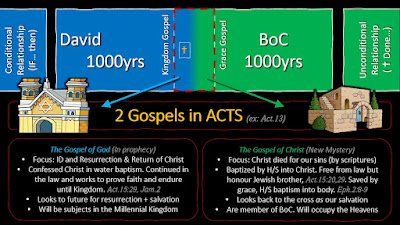
In the previous study we discussed how Paul, during the first half of his ministry, —that is, his missionary ministry represented in ACTS, —preached two gospels. The general trend that Paul would follow is;

He would preach the gospel of God to those Jews and Gentiles (friends of the Jews) who came together, typically, but not exclusively, in the Jewish synagogues. The gospel of God in summary was,

  • believe in Jesus' resurrection and 2nd coming, repent, be water baptized, receive the Holy Spirit, obey the law, prove your faith with works, and endure to the end.

Then, to those who believed Paul's preaching of the above gospel, he would introduce them to the 'mystery' gospel of Christ.

  • that Jesus died for their sins and that they could trust in nothing else but the all-sufficient cross-work of Christ (death, burial, resurrection) for salvation.

Understanding the New Testament Gospel Differences (Part 8)

Understanding the New Testament Gospel Differences (Part 8 --- Accompanying signs)


We continue with the comparison of the gospel of God and the gospel of Christ by looking at key elements that distinguish them from each other. I recommend to start at the beginning of this comparison to gain the necessary context of this series of posts.

The Kingdom gospel and the gospel of God had accompanying signs

The earthly ministry of Jesus was validated by a myriad of signs (or miracles) that He performed. These signs, according to prophecy, were to validate His ministry and prove to the Jews that He was their Messiah. To confirm this, John ends his gospel with a remarkable statement;

John 21:24-25 This is the disciple which testifieth of these things, and wrote these things: and we know that his testimony is true. 25 And there are also many other things which Jesus did, the which, if they should be written every one, I suppose that even the world itself could not contain the books that should be written. Amen.

Understanding the New Testament Gospel Differences (Part 7)

Understanding the New Testament Gospel Differences (Part 7 --- The meaning of Christ's death was unknown)


We continue with the comparison of the gospel of God and the gospel of Christ by looking at key elements that distinguish them from each other. I recommend to start at the beginning of this comparison to gain the necessary context of this series of posts.

The meaning of Christ's death was unknown during the Gospels and early Acts

During Jesus early ministry, His followers did not know that the purpose of His first advent was to sacrifice Himself. According to their prophetic scriptures, Jews believed that when their Messiah would come, He would come as a King and a conqueror. 

Eternal Life or Eternal Death - Man's Choice

Eternal Life or Eternal Death – Man's Choice

Article written by Arthur J Licursi (on his website here)


The "gospel of Christ" is the most glorious offering our creator God could make unto lost mankind.

"For I [Paul] am not ashamed of the Gospel of Christ: for it [Paul's "gospel of the grace of God" for this age] is The Power of God unto Salvation to every one that BELIEVETH…" (Romans 1:16 (KJV))

The one caveat in the above verse is to "BELIEVE," trusting in Christ, as the Sole Basis of One's Salvation. This means all men are free to Choose Salvation unto eternal life or, alternatively, they may reject Christ… unto "everlasting destruction."

Understanding the New Testament Gospel Differences (Part 6)

Understanding the New Testament Gospel Differences (Part 6 --- Call upon the name of the Lord or confess His name)


We continue with the comparison of the gospel of God and the gospel of Christ by looking at key elements that distinguish them from each other. I recommend to start at the beginning of this comparison to gain the necessary context of this series of posts.

Call upon the name of the Lord or Confess the Lord

In the Old Testament and the four Gospels, it was required by Jews to call upon the name of the Lord or confess His name. The purpose for this was to make a positive identification of Him based on the signs the scriptures gave about their Messiah, and in so doing individually proclaim their faith in Him. To call upon the name of the Lord, or to confess Him as their Messiah, was a necessary requirement of salvation during the law dispensation and in the Kingdom gospel and the gospel of God.